
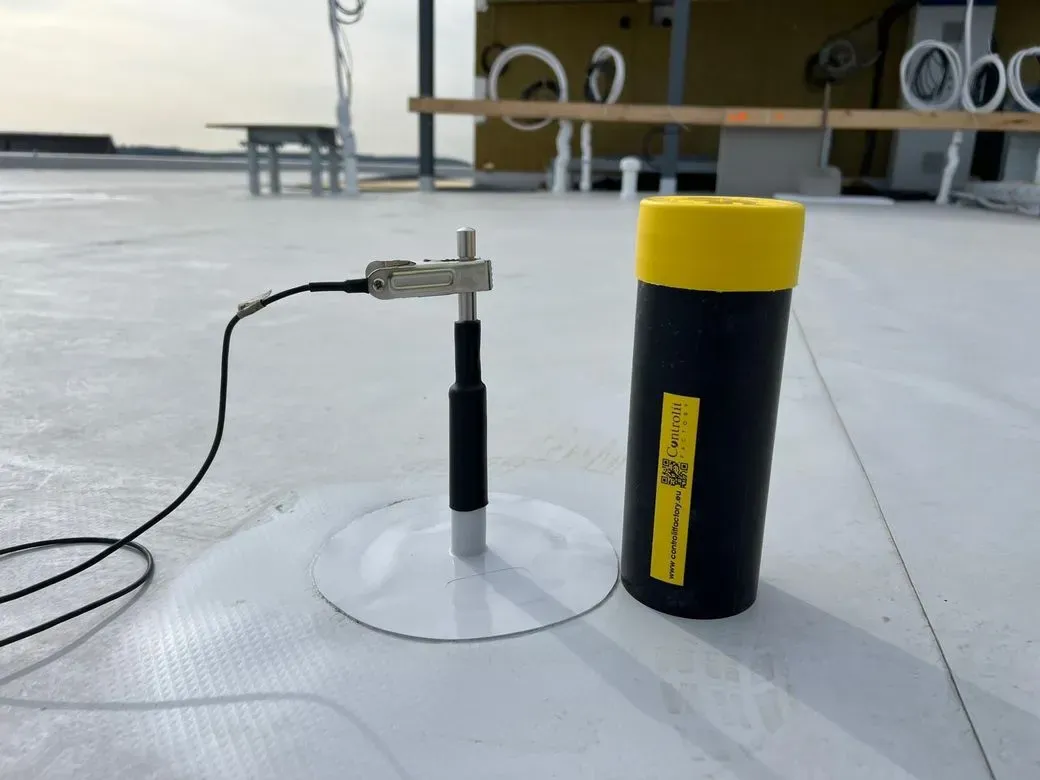
Electronic Leak Detection is a testing method. It can be used forensically, to locate the source of an active leak, or preventively, to find breaches before water enters the assembly.
I make a clear distinction between the two terms, "leak" and "breach". A breach is an opening in a waterproofing layer — a puncture, a tear, any damage that can allow water to enter the assembly. A leak is simply a breach plus water.
When designing a roofing system for ELD, the goal must be preventive.
You wouldn't design a new system to find leaks, unless you already accept that your system will leak — which defeats the purpose of waterproofing.
The goal is integrity testing: assessing watertightness at predefined milestones to either confirm performance, or to find and repair defects before they become leaks.
For that to work, physics applies.
How Preventive Testing with ELD Works
ELD requires a conductive substrate located directly beneath the waterproofing layer(s). An electrical current is applied at the membrane surface with an ELD equipment.
At any breach, current discharges into the conductive substrate below. That discharge signals the operator and locates the breach.
No conductive substrate. No discharge. No signal. No detection.
This is not a preference or a specification detail. It is the physical condition on which the entire method depends.
Why Substrate Quality Determines Test Quality
The conductive substrate does not just enable testing. It determines its accuracy.
Variations in conductivity, gaps in coverage, or degradation over time directly affect what the test can and cannot find. A substrate that works partially produces results that are partially reliable, and there is no way to know where the gap is.
The goal of designing a system for ELD is not to make testing possible. It is to make testing trustworthy. Accurate enough to act on. Repeatable enough to rely on over the building's lifespan.
For that, the conductive substrate must meet five criteria:
- High conductivity. Electrical resistance below 10,000 ohms, as per ASTM standards. Reference products on the market operate around 1,000 ohms.
- Continuous and uniform. A stable conductive plane across the entire waterproofing surface, with no gaps and no variation in conductivity.
- Longevity. The substrate's electrical properties must remain stable over time, during construction and years into the building's operational life.
- Seamless integration. The conductive layer must integrate into the assembly without introducing additional risks to the waterproofing system.
- Compatibility with both ELD methods. High-Voltage and Low-Voltage testing have different physical requirements. A properly designed substrate supports both, providing flexibility across site conditions and testing stages.
Why Poor Design Is Widespread
ELD is being specified on more and more projects. That is a good sign. It means the industry is moving toward verification, toward measurable performance, toward something better than visual inspection and flood testing.
But specifying ELD is not the same as designing for ELD.
A specification that names the method without defining the conditions for it to work produces nothing more than a line in a document. It creates the appearance of rigor without the substance. And because the result looks like a test report, nobody questions it.
That is how poor design becomes standard practice. Not through negligence. Through the assumption that naming something is the same as understanding it.
What Happens When These Criteria Are Not Met
A system that doesn't meet all five criteria will not necessarily fail completely. It may produce some results. Moisture in the assembly or other uncontrolled site conditions can create partial conductive paths that allow some detection.
But partial is the problem.
You do not know what percentage of the surface was accurately tested. You do not know how many breaches were missed. And you cannot repeat the test under the same conditions — not next year, not in five years.
What you have is a result. What you don't have is certainty.
This matters more today than it ever did. Electronic Leak Detection was initially developed to find leaks, as a forensic application. That use does not require certainty. You are looking for a signal, and any signal helps.
But ELD is now designed into new roofing assemblies specifically to allow preventive, accurate, and repeatable integrity testing — to prevent leaks altogether. That application requires a completely different standard. Not some signal. All of it.
The Standard Has to Be Higher
If the goal is leak prevention, partial detection is not a step in the right direction. It is a different goal entirely.
Prevention requires knowing the full state of the membrane. Not most of it. Not the areas where conditions happened to allow a signal. All of it, under controlled and repeatable conditions, at every critical stage of the building's life.
Integrity testing without certainty is not integrity testing. It is an approximation presented as assurance. That is what poor conductive layer design produces. Not always failure. Sometimes just enough signal to create confidence that isn't warranted. And that, more than no result at all, is the real risk.
Anything less is not prevention. It is managed uncertainty — which is exactly what the industry has always accepted, just with more expensive equipment.
The standard has to be higher. Water doesn't care what the test report says.
Designing a roofing system for ELD? Contact us to review your specification before it becomes a problem.